
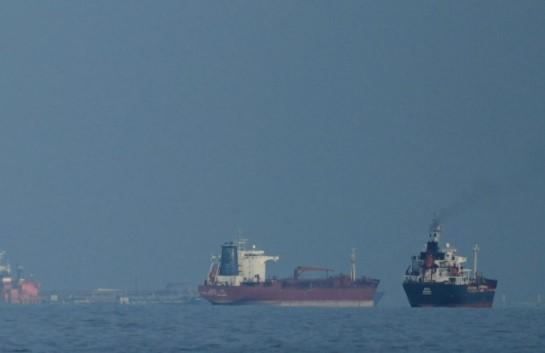
President Donald Trump on Sunday said the U.S. Navy would swiftly begin a blockade of ships entering or leaving the strategic Strait of Hormuz, after U.S.-Iran ceasefire talks in Pakistan ended without an agreement.
U.S. Central Command announced the blockade would involve all Iranian ports, beginning on Monday at 10 a.m. EDT, or 5:30 p.m. in Iran, to be “enforced impartially against vessels of all nations.”
However, CENTCOM said it would still allow ships traveling between non-Iranian ports to transit the strait. Its announcement was a step down from the president’s earlier threat to blockade the entire strait, and allows traffic to flow in the crucial waterway as long as it avoids Iranian ports.
Trump wants to weaken Iran’s key leverage in the war after demanding that it reopen the strait to global traffic on the waterway that was responsible for 20% of global oil shipping before fighting began.
That traffic has been limited even in the days since the ceasefire. Marine trackers say over 40 commercial ships have crossed since the start of the ceasefire.
A U.S. blockade could further rattle global energy markets.
Oil prices rose in early market trading on Sunday after the blockade announcement. The price of U.S. crude rose 8% to $104.24 a barrel, and Brent crude oil, the international standard, rose 7% to $102.29. Brent crude cost roughly $70 per barrel before the war in late February.
Iran’s Revolutionary Guard later said the strait remained under Iran’s “full control” and was open for non-military vessels, but military ones would get a “forceful response,” two semi-official Iranian news agencies reported.
During the 21-hour talks this weekend in Pakistan, the U.S. military said two destroyers had transited the strait ahead of mine-clearing work, a first since the war began. Iran denied it.
Trump’s plan to use the Navy to block the strait is unrealistic and he will have to concede on some issues with Iran, said Andreas Krieg, a senior lecturer in security studies at Kings College London. “There isn’t any tool in the toolbox in terms of the military lever that he could use to get his way,” Krieg said.
Trump said Tehran’s nuclear ambitions were at the core of the talks’ failure. In comments to Fox News, he again threatened to strike civilian infrastructure.
Iranian parliament speaker, Mohammad Bagher Qalibaf, who led Iran’s side in the talks, addressed Trump in a new statement on his return to Iran: “If you fight, we will fight.”