
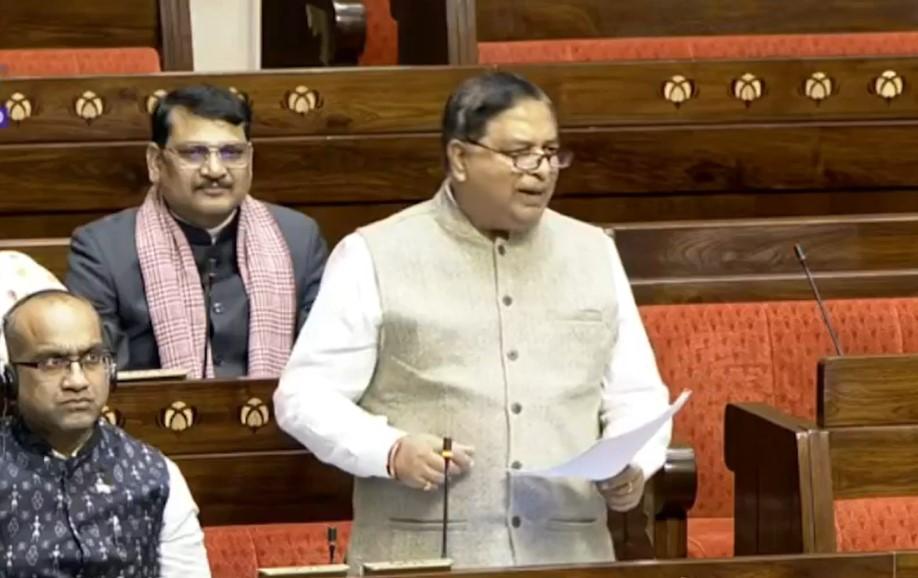
Jammu & Kashmir BJP President and Rajya Sabha MP Sat Sharma (CA) delivered a forceful maiden speech in Parliament, wholeheartedly supporting the Vande Mataram Bill and congratulating Prime Minister Narendra Modi and the Union Government for dedicating an entire year to honour the national song. Calling it a “historic cultural renaissance,” he said the initiative reflects the government’s deep respect for India’s civilizational ethos and national pride.
Sat Sharma highlighted that while India gained independence on 15 August 1947, Jammu & Kashmir attained unification with the nation on 26 October. “We, the people of J&K, have endured the poison of slavery for decades,” he said, recalling a painful history when those who sang Vande Mataram faced bullets, atrocities, and discrimination. The innocent residents of Jammu & Kashmir were fired upon for singing the national song, with many losing their lives between 1952–53, several individuals from Jourian, Sunderbani, Hiranagar, and Ramban were killed, including Bhikam Dass, who was martyred merely seven days after his marriage for carrying the Tricolour.
He reminded the House of the sacrifices of Dr. Shyama Prasad Mookerjee, who laid down his life fighting against the dual constitutions and symbols imposed on J&K. “We have witnessed separatism, terrorism, and countless hardships even after independence,” he said.
Sat Sharma expressed profound gratitude to PM Modi for the watershed moment of 5 August 2019, when Article 370 was abrogated. “Before this historic step, students carried stones in their school bags, Gorkha community members could not vote, daughters of J&K lost their rights after marriage outside the state, Valmiki community workers were denied civil rights, and West Pakistan Refugees were excluded from the Assembly. The Modi government restored dignity, equality, and justice to the people of J&K,” he stated.
He strongly criticized the earlier political leadership that, according to him, created and perpetuated decades of suffering. Praising the Modi government for its nationalistic initiatives, he welcomed the introduction of commemorative postal stamps and coins celebrating Vande Mataram, calling them “a proud acknowledgement of India’s cultural nationalism.”
Tracing the song’s origins to Bankim Chandra Chattopadhyay’s 1875 creation, Sat Sharma recounted how Vande Mataram became the rallying cry of India’s freedom struggle. He condemned the Congress for diluting and restricting the song, citing the 1937 Congress Working Committee decision limiting the acceptance of only the first two stanzas. “Who were those ‘other people’ they referred to, and what were they objecting to?” he questioned, emphasizing that only those who abruptly gained power could think in this manner.
He also referenced criticisms by Sheikh Abdul Majid in 1937, who pushed for replacing Vande Mataram with Sare Jahan Se Acha, and noted that even Jinnah opposed such positions. He recalled how during British rule, singing Vande Mataram led to cane-charging, criminal cases, and even de-affiliation of schools.
Sat Sharma said that the celebration of 150 years of Vande Mataram is a fitting tribute to India’s cultural spirit and a reaffirmation of the Modi government’s dedication to Indian values, Swadeshi ethos, and national identity. Praising its inclusion in school textbooks, he said it instills patriotism in young minds.
He concluded by invoking Pandit Deendayal Upadhyaya’s message—“Lok shakti ka nirmaan karke swaraj se suraaj banana”—affirming that the Vande Mataram Bill represents India’s journey from political freedom to good governance rooted in cultural pride.