
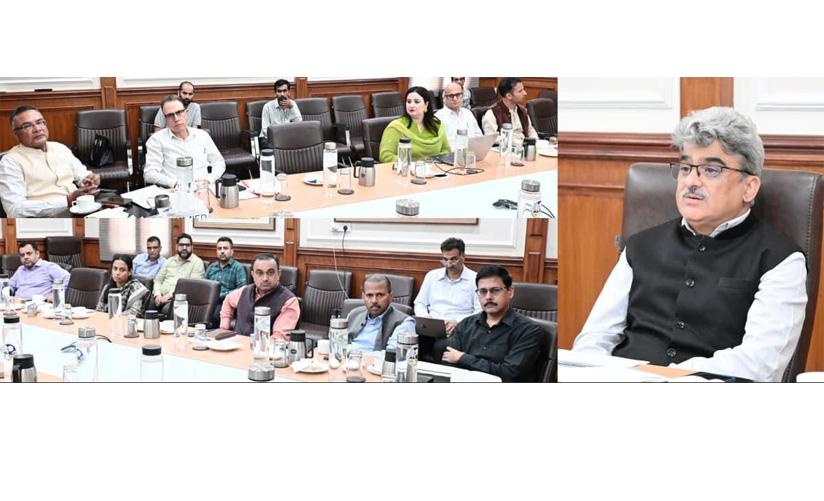
Chief Secretary, Atal Dulloo today chaired a high-level review meeting to assess the roadmap and ongoing initiatives aimed at strengthening disaster management mechanisms across the Union Territory of Jammu & Kashmir.
Emphasizing a proactive and resilient approach, the Chief Secretary directed the concerned departments to effectively plan and utilize funds amounting to ₹3,340 Cr earmarked under various components of disaster management, mitigation, and risk reduction across all districts.
The meeting was attended by Additional Chief Secretary, Finance; Additional Chief Secretary, PWD; Principal Secretary, DMRR&R; Divisional Commissioner, Jammu/Kashmir, Director CD & SDRF; CEO, ERA, and other senior officers. Deputy Commissioners from all districts participated through video conferencing.
During the meeting, the Chief Secretary underscored the need for a focused and structured approach across six key verticals of disaster management including Early Warning Systems, Risk Reduction, Relief & Response, Rehabilitation, Reconstruction, and Capacity Building & Training. He called for sustained efforts to build a disaster-resilient Jammu & Kashmir through long-term, evidence-based planning.
Stressing the importance of expert-driven policy formulation, he directed the department to undertake detailed analysis through the constituted expert committee for developing precise, actionable recommendations tailored for each department. He further emphasized leveraging mitigation funds under Glacial Lake Outburst Floods (GLOF), landslides, and floods, to reduce vulnerabilities and enhance preparedness.
Highlighting the approaching monsoon season, the Chief Secretary instructed all Deputy Commissioners to identify vulnerable areas in advance and implement preventive measures based on past experiences. He also laid emphasis on strict enforcement of disaster management laws, calling for the formulation of Standard Operating Procedures (SoPs) and their effective implementation at the district level to ensure compliance and accountability.
Additional Chief Secretary, Finance, Shailendra Kumar, stressed the need to safeguard critical connectivity infrastructure along with life and property. He advocated for adoption of modern, technology-driven early warning systems and recommended detailed studies of vulnerable regions, particularly the Chenab basin, to guide mitigation strategies.
Additional Chief Secretary, PWD, Anil Kumar Singh, highlighted the department’s efforts towards permanent restoration of damaged infrastructure and implementation of mitigation measures aimed at ensuring minimal disruption to connectivity during disasters.
Principal Secretary, DMRR&R, Chandraker Bharti, informed that comprehensive mitigation guidelines have already been issued, urging departments to formulate projects in accordance with these guidelines to secure funding. He also indicated that fresh allocations would soon be released to districts to address emergent situations.
Divisional Commissioner, Jammu, Ramesh Kumar, highlighted the importance of training and capacity building of volunteers, especially in remote and far-flung areas, to significantly reduce response time.
Similarly Divisional Commissioner, Kashmir, Anshul Garg, called for strengthening early warning mechanisms, flood zoning, and modelling, along with early operationalization of the Emergency Operations Centre (EOC) at Budgam.
Director SDRF, Imtiyaz Hussain Mir, emphasized the need for augmenting manpower and strengthening logistical capacity, including procurement of advanced equipment to enhance disaster response capabilities across the UT.
The CEO, ERA, Shreya Singhal apprised the meeting about the current status of completion of the EOC at Budgam assuring that the department is trying its best to partially handover the same for use by April end after construction of boundary wall and completing ig fully by August this year. She also divulged that the necessary procurement of equipment has also been undertaken for its smooth operation soon.
Deputy Commissioners also shared field-level insights, highlighting requirements related to consultancy support, equipment, and capacity building, while also detailing measures taken in response to past disasters.
Earlier, the Department presented a comprehensive roadmap for upgrading disaster management systems in the UT. It was informed that a Multi-Hazard Vulnerability and Risk Assessment is currently underway, with pilot districts including Ramban, Kishtwar, and Srinagar. A dedicated expert committee has been constituted, and a Risk Atlas is being developed to identify critical hazard hotspots.
It was added that the Department has also secured substantial financial assistance, including over ₹330 Cr from the High-Level Committee on the basis of IMCT report besides over ₹1,579 Cr had been approved by the Ministry of Home Affairs for recovery and reconstruction of infrastructure here in J&K. Additionally projects worth ₹1,431 Cr under SASCI had been allocated for restoration of damaged infrastructure too.
In order to institutionalize the mechanism the UT has established a Directorate of Disaster Management, while steps are underway for the creation of an Urban Disaster Management Authority. A dedicated Mitigation Fund has been operationalized, supported by project appraisal committees to facilitate targeted interventions.
In a significant step towards strengthening institutional capacity, the Department has signed an MoU with UNDP for technical support and is working closely with the National Disaster Management Authority (NDMA) to develop hyper-local early warning systems. The Incident Response System (IRS) has been notified up to the tehsil level, complemented by regular mock drills and capacity-building programmes.
Key capacity-building initiatives include specialized training programmes for engineers, officers, and community stakeholders, along with a focus on gender-inclusive disaster risk reduction strategies. Priority is also being given to landslide risk mitigation and structural safety assessments.
Line departments such as Housing & Urban Development, Public Works (R&B), and Jal Shakti are actively integrating disaster-resilient features into infrastructure planning, including earthquake-resistant construction, floodplain mapping, slope stabilization, and installation of advanced flood monitoring systems.
The UT Government has also initiated critical policy reforms, including strengthening building bye-laws, enforcing land-use regulations, floodplain zoning, and mandating disaster risk reduction measures in all major developmental projects, reaffirming its commitment to building a safer and more resilient Jammu & Kashmir.