
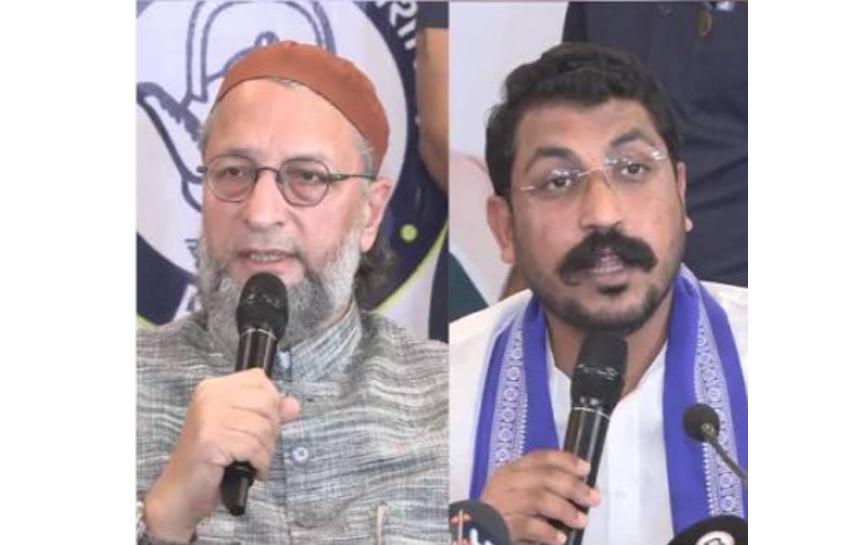
AIMIM chief Asaduddin Owaisi and Azad Samaj Party (Kanshiram) leader Chandrashekhar Azad on Thursday (November 12) joined hands for the 2027 Uttar Pradesh Assembly elections. The two parties, AIMIM and ASP, announced the alliance and formation of the 'Samajik Parivartan Morcha' to jointly contest the polls.
The announcement was made by Aazad in the presence of AIMIM president and Lok Sabha MP Asaduddin Owaisi at a press conference in Lucknow.
What did Owaisi say?
Owaisi described the alliance as "large-hearted" and said it was open to other parties, including the Samajwadi Party and the Congress, joining it in the electoral contest. He said any party willing to prevent the BJP from returning to power in Uttar Pradesh was welcome to contest the elections in support of the alliance.
Owaisi also said that Chandrashekhar Azad will be SPM coalition's CM face in 2027 polls.
Addressing the media, Owaisi said, "On behalf of our party, I would like to state that we are committed to making this 'Samajik Parivartan Morcha' a success. It gives me great pleasure to announce that our brother, Chandrashekhar Azad, will be the Chief Ministerial candidate for the 'Samajik Parivartan Morcha' in Uttar Pradesh. We will all work together to ensure the success of this alliance—a success that will ultimately be the success of the people of Uttar Pradesh. Once Chandrashekhar Azad becomes the Chief Minister, we will be able to implement the changes we envision."
What did Chandrashekhar Azad say?
Rejecting the description of the alliance as a 'third front,' Azad said it could emerge as a strong political platform representing the deprived, oppressed and marginalised sections of society.
"People have been calling it a third front, but it is not a third front. It is the Samajik Parivartan Morcha. If you understand its depth, you will realise that it is the first front," he said.
Azad said the alliance aimed to bring weaker and deprived sections together and help them convert their electoral strength into political power to address their concerns.
Invoking BR Ambedkar, he said political power was the "master key" to resolving people's problems and argued that communities without their own political organisation could not effectively protect their interests, irrespective of their population.
He said Ambedkar had formed political organisations, including the Scheduled Castes Federation, the Indian Labour Party and the Republican Party of India, after realising that existing political parties would not adequately represent the interests of marginalised communities.
Aazad alleged that successive governments had failed to fulfil promises of bringing deprived communities into the mainstream, addressing poverty and preventing atrocities against them.
May contest elections on around 150 seats
The newly formed alliance is reportedly considering contesting around 150 Assembly seats in Uttar Pradesh.
Ahead of the formal announcement, AIMIM's Uttar Pradesh chief, Shaukat Ali, launched a sharp attack on the Samajwadi Party (SP). He claimed that AIMIM had offered alliance proposals to both the SP and the Congress, but they had rejected them due to their arrogance.
Ali said AIMIM would teach Akhilesh Yadav a lesson in Uttar Pradesh, just as it had challenged RJD leader Tejashwi Yadav in Bihar. He further claimed that the party would restrict the SP chief to just 27 seats in the 2027 Assembly elections.
Could the alliance upset Akhilesh Yadav's electoral plans?
With Owaisi and Azad joining hands, questions are being raised over whether the alliance could affect the electoral prospects of Akhilesh Yadav and the Samajwadi Party. The proposed partnership is being viewed as an attempt to bring Dalit and Muslim communities onto a common political platform and build an alternative political formation in the state.
It is worth noting that Muslims and Dalits account for approximately 20% and 21% of the vote in UP, respectively. The Muslim vote has a direct impact on 143 seats, while the Dalit vote is a significant factor in 150 seats. In this context, the Owaisi-Chandrashekhar alliance could emerge as a challenge not only for the Samajwadi Party but also for Mayawati's Bahujan Samaj Party (BSP).
Muslim population: Around 20 per cent, with an electoral influence in 143 constituencies.
Dalit population: Around 21 per cent, with an electoral influence in 150 constituencies.
Samajik Parivartan Morcha: May contest around 150 Assembly seats.