
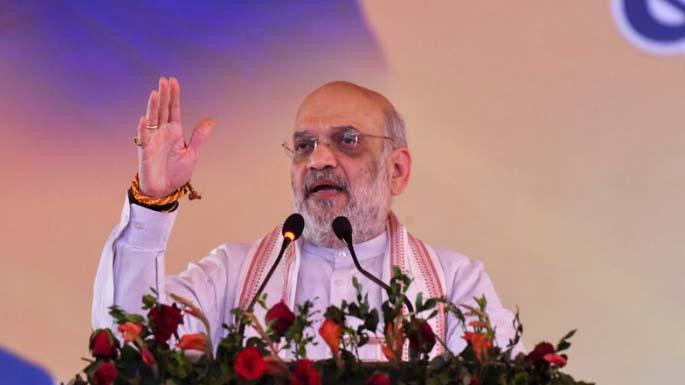
Union Home Minister Amit Shah on Saturday said Naxalism would be eliminated from the country by the March 31 deadline set by the government.
Addressing the 87th CRPF Day Parade here, the first ever in the northeast, Shah said the force played an important role in Jammu and Kashmir, where the number of stone-pelting incidents has dropped to zero, besides being deployed to handle ethnic violence in Manipur and breaking the back of Maoists in only three years.
Naxalism had spread across 12 states and countless districts of the country, and when the Centre resolved to uproot the menace, the CRPF and CoBRA force personnel played the most crucial role in the effort, he said.
The home minister noted that such a huge, complex and difficult task was completed in just three years.
“Because of the CRPF personnel, we can confidently say that by March 31, 2026, the country will be completely free from Naxalism,” he asserted.
Praising the force for Operation Black Forest in the Karreguta Hills on the Chhattisgarh-Telangana border, in which 31 Naxals were killed in April-May 2025, Shah said CRPF personnel carried out the operation over 21 days in extremely-challenging geographical conditions, enduring a temperature of 45 degrees Celsius under the scorching sun, and eliminated the Naxalites’ stronghold.
He said displaying exceptional courage, the CRPF jawans did not retreat even an inch while operating for those 21 days on rocky hills heated up by extremely-high temperatures, ultimately dismantling the strategic base of Naxalites.
Shah said the CRPF and the CoBRA force have made a very significant contribution in freeing the country from “red terror”.
He pointed out that 14 CRPF jawans were awarded the Police Medal for Gallantry on Saturday, five received the President’s Police Medal for Distinguished Service and five battalions of the force were honoured with medals for outstanding performances.
Assam Chief Minister Himanta Biswa Sarma, CRPF Director General G P Singh and many other dignitaries were present on the occasion.
Earlier, Singh said Operation Black Forest “broke the back” of Naxals.
He asserted that Naxalism would be eliminated from the country by the March 31 deadline given by the government.
Shah said in the 86-year history of the CRPF, this was the first time that the force’s Raising-Day celebrations were held in the northeast, in Assam, which is a matter of pride for everyone and the entire region.
“In 2019, it was decided that the annual parade of the Central Armed Police Forces (CAPFs) would be held in different parts of the country. And today, the CRPF parade is being held in one of the most important parts of the country — the northeast,” he said.
Eight CRPF contingents, drawn from formations across the country, staged a ceremonial parade at the meticulously-groomed Sarusajai Stadium here.
Resplendent in colourful headgear and marching to the reverberating drumbeats, the march past drew a sustained applause from a large crowd.
The parade was led by Commandant Deepak Dhoundiyal of the 225th Battalion.
The marching units represented the Northern Sector, comprising women personnel, as well as contingents from the North Western sector, Jharkhand, Odisha, the Rapid Action Force (RAF), the CoBRA unit and the Western and North Eastern sectors.
The ceremony concluded with a series of precision displays and tactical demonstrations. Women personnel executed an intricate rifle drill, commandos simulated a high-risk hostage-rescue operation and CoBRA commandos staged a jungle-warfare exercise, depicting an anti-Naxal operation.
Underlining that India’s internal security cannot even be imagined without the CRPF, Shah said since its inception, the force has stood as a strong internal-security pillar due to its dedication to duty and has been delivering results as well.
He said 2,270 CRPF jawans have made the supreme sacrifice to keep India safe and the entire country thanks and pays tributes to them.
The home minister said it is precisely because of this dedication to duty and the sacrifices made that the CRPF jawans have protected the country on numerous occasions.
“Eleven-twelve years ago, the country had three major hotspots — Jammu and Kashmir, Left-Wing Extremism-affected areas and the northeast — which had become sores for internal security. Today, success has been achieved in establishing peace at all three places,” he said.
Shah said bomb blasts, bullets, bandhs, blockades and destruction were once prominent at these three hotspots but now, all three regions have become engines of growth, driving the development of the entire country forward.
He asserted that without the sacrifices made by the CRPF personnel, it would have been impossible to bring these three hotspots onto the path of development.
Shah pointed out that the CRPF’s journey began in 1939 with just two battalions and today, with 248 battalions and a strength of 3.25 lakh personnel, it has become the world’s largest CAPF.
He said even when 78 police personnel in Kolkata were killed in an attack by Left-wing extremists, the CRPF continued to hold the front with courage.
The home minister noted that the force also foiled a terrorist attack on Parliament and thwarted an attack on the Shri Ram Janmabhoomi in 2005.
After the abrogation of the provisions of Article 370 of the Constitution, not a single bullet had to be fired in Jammu and Kashmir and the CRPF played a very significant role in ensuring this, he said.
Shah added that the number of stone-pelting incidents has come down to zero in Jammu and Kashmir, industries are coming in and development is taking place, thanks to major contributions from the CRPF, BSF and especially, the Jammu and Kashmir Police.
He also said the CRPF played a big role in establishing peace in the north-eastern states.
The home minister said whether it is the Amarnath Yatra or the Maha Kumbh, the force has played a major role in ensuring the safety and success of the country’s cultural events as well.
He noted that 700 CRPF personnel were killed in the northeast, 780 in Naxal areas and 540 in Jammu and Kashmir.
“Without these sacrifices, it would have been impossible to take these three hotspots on the path of development today. If I talk about Assam, 79 jawans have done their best to establish peace in Assam,” Shah said.
The first battalion of the force was raised in 1939 as the Crown Representative’s Police (CRP) under the British rule.
Post Independence, in 1949, it was re-christened as the Central Reserve Police Force under the Indian Union by the first home minister, Vallabhbhai Patel.