

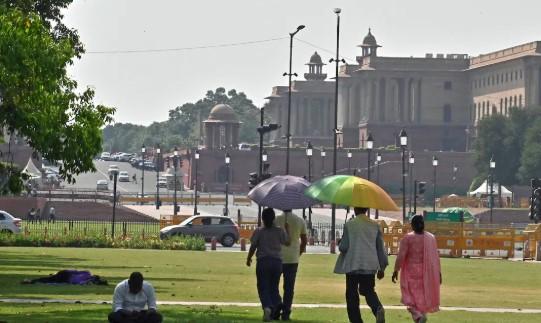
The national capital witnessed its hottest day of 2026 on Saturday (April 25) as several parts of the city reported heatwave conditions. According to the India Meteorological Department (IMD), temperatures soared across multiple locations even as forecasts signalled the likelihood of rain from Monday to Wednesday. A yellow alert was issued for Saturday, with a similar warning in place for Sunday due to the possibility of isolated heatwave conditions.
The Safdarjung observatory, considered Delhi's primary weather marker, registered a maximum temperature of 42.8 degrees Celsius. This was 5.1 degrees above normal and nearly a degree higher than Friday, meeting the IMD's heatwave criteria. This temperature is the highest recorded in the city since April 28, 2022, when the maximum had touched 43.5 degrees Celsius. Safdarjung also reported a minimum of 25.2 degrees Celsius, which was 2.5 degrees above normal.
Multiple stations log heatwave conditions
Other weather stations across Delhi reported similar conditions. Lodhi Road recorded a maximum temperature of 42.6 degrees Celsius, while Ridge logged 44.5 degrees. Ayanagar reported 43.2 degrees, all above seasonal averages. The IMD initially marked Friday (April 24) as the first isolated heatwave day of the season but later clarified that it was actually the third consecutive day. Officials explained that heatwave classification applies to the entire Haryana-Chandigarh-Delhi subdivision. "On Thursday, one station, Rohtak to be specific, of Haryana and Ridge of Delhi, had satisfied heatwave criteria, thus making it the first day. Saturday was the third consecutive day of heat waves," they added.
IMD expects some relief next week
Despite the ongoing oppressive heat, the weather department expects temperatures to ease slightly from Monday. Very light rain, thunderstorms and gusty winds are possible from Monday to Wednesday. Maximum temperatures may dip to 38-40 degrees Celsius by the end of next week, while minimum temperatures are likely to hover between 25 and 27 degrees Celsius.
Air quality remains in poor category
The 24-hour average AQI recorded by the Central Pollution Control Board stood at 243, categorised as poor. This marked an increase from Friday’s AQI of 226. As per CPCB norms, anything between 201 and 300 falls in the poor range. A forecast from the Air Quality Early Warning System suggests that the AQI may stay in the poor category over the weekend before improving to moderate levels next week.