
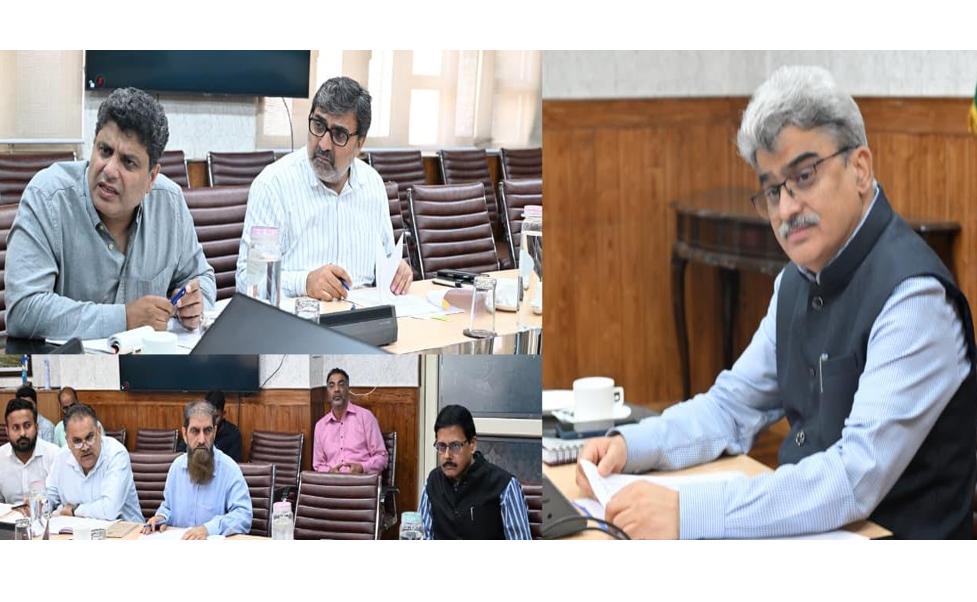
Chief Secretary, Atal Dulloo today chaired the 12th Executive Council Meeting of the J&K Rehabilitation Council for Orphans, Women and Disabled Persons to review its functioning, achievements and action plan for 2026-27.
The Meeting besides the Commissioner Secretary, Social Welfare Department was attended by Secretary in Social Welfare Department; DG, Budget; and Executive Director, Rehabilitation Council here.
The meeting reviewed major welfare interventions undertaken during the previous financial year and approved an expanded roadmap focused on improving mobility and self-reliance among specially-abled persons besides providing greater national exposure and opportunities to children from vulnerable and economically weaker sections.
A major focus of the meeting was the free distribution of retrofitted motorized tricycles to eligible orthopedically disabled persons of J&K. The initiative prioritizes students, girl students, artisans and small vendors who possess a Priority Household (PHH) ration card and have at least 40 per cent locomotor disability.
It was given out by the Commissioner Secretary, SWD, Sarmad Hafeez that during 2025-26, against an approved proposal of ₹13 crore, the Social Welfare Department released ₹11.05 crore under the CAPEX Budget to the State Motor Garages Department for procurement of around 1,284 motorized tricycles at an approximate cost of ₹86,000 per unit through the Government e-Marketplace (GeM).
Similarly for 2026-27, the Council has proposed ₹12.95 crore for procurement of around 1,500 units, with an initial ₹4 crore already released after completion of mandatory codal formalities by the Department.
The Chief Secretary also reviewed the implementation of the ‘Watan Ko Jano’ Youth Exchange Programme, being fully funded and supported by the Ministry of Home Affairs (MHA), Government of India, since 2012.
The programme provides children and youth from vulnerable sections, including children of militancy-hit victims, specially-abled children and those belonging to economically weaker sections, an opportunity to experience the cultural diversity and developmental progress of different parts of the country.
Under the programme, the Executive Director of the Council divulged that around 250 children from EWS families, studying in government schools and residing in Palash and Parisha Homes managed by the Social Welfare Department, undertook a visit to Lucknow and New Delhi in April 2026, accompanied by 23 coordinators. During the visit, the children also had the opportunity to meet and interact with the President of India and Vice President of India.
Moreover, building on the initiative, the Council is going to take more 400 children on national exposure visits in two phases during 2026-27, covering the Mumbai–New Delhi and Jaipur–New Delhi circuits, with funding already secured from the MHA.
The Chief Secretary directed the concerned departments to fast-track procurement and implementation processes while maintaining complete transparency and adherence to prescribed procedures.
He also stressed maximizing outreach and ensuring that welfare schemes translate into tangible benefits for eligible beneficiaries at the grassroots level, with particular attention to empowerment and social inclusion of vulnerable sections across the cross section of the society here.