
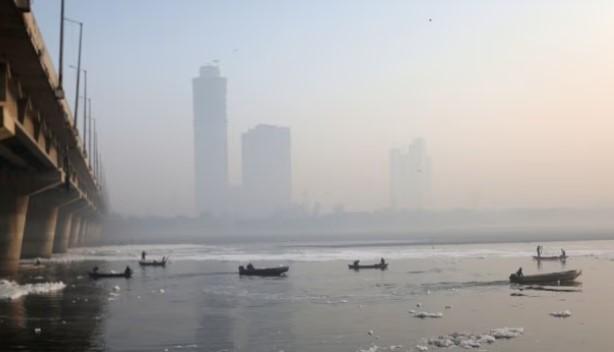
A thick blanket of smog continued to smother Delhi-NCR on Saturday, pushing the Capital’s 24-hour average air quality index (AQI) to 431, in the Severe category, prompting the authorities to impose the strictest anti-pollution curbs under Graded Response Action Plan Stage 4 (GRAP 4). Delhi’s 24-hour average AQI went up to 457 at 10 pm, as per CPCB data.
The Delhi Directorate of Education directed all schools to conduct classes for students up to Class IX and XI in a hybrid mode in light of the deteriorating AQI. This decision follows an order issued by the Commission for Air Quality Management (CAQM), which invoked Stage IV actions under GRAP.
The hybrid model is applicable to schools in Gurgaon, Faridabad, Ghaziabad and Gautam Buddha Nagar as well, a CAQM order stated.
In an official order, the Delhi government directed that all administrative secretaries and heads of departments shall attend office regularly, with no more than 50% staff strength physically present.
“The remaining 50% staff shall work from home, provided that the administrative secretaries and heads of departments can call officers/officials to the office, as required to ensure uninterrupted delivery of essential and emergency public services,” the order read.
Likewise, the order stipulated that all private offices operating within Delhi shall function with no more than 50% staff physically attending the workplace. “The remaining staff shall mandatorily work from home,” it added.
The order also urged all private entities to implement staggered working hours where feasible. Furthermore, private offices have been instructed to ensure strict compliance with work-from-home norms and minimise vehicular movement related to office commutes.
Other NCR states have been given similar directions by CAQM, while the Union government may take a call on work-from-home arrangements for its employees.
Further, stringent vehicular restrictions have come into effect, and all kinds of construction and demolition activity has been disallowed. (See box)
Saturday recorded the worst air quality of the year so far, surpassing the previous high of 428 recorded on November 11. According to IITM’s air quality forecast, Delhi’s AQI is expected to be in the ‘Severe’ category on Sunday as well, following which it is likely to improve to the ‘Very Poor’ (301-400) category.
According to CAQM, the AQI deteriorated rapidly throughout the day. “Delhi’s AQI, which was recorded as 431 at 4 pm, exhibited an increasing trend… owing to slow wind speed, stable atmosphere, unfavourable weather parameters and meteorological conditions and lack of dispersal of pollutants,” it said.
At this time of the year, temperature inversion sets in over the region, with colder air trapped close to the ground beneath a layer of warmer air above it. This prevents vertical mixing of air, and combined with near-calm wind conditions, the same acts like a lid over Delhi, stopping pollutants from dispersing. As a result, emissions from vehicles, biomass burning and industrial activity accumulate rapidly, leading to sharp spikes in pollution levels.
According to IITM’s Decision Support System (DSS), the vehicular sector remained the largest contributor (around 18%) to pollution on December 12, followed by industries (around 10%). Pollution transported from neighbouring areas also added significantly to Delhi’s PM2.5 load, with Jhajjar contributing around 13% and Sonipat 8.6%, while emissions from the residential sector were recorded at about 5%.
Meanwhile, during the 23rd meeting of its Sub-Committee on Safeguarding and Enforcement on Friday, CAQM has reviewed sector specific enforcement action to curb pollution.
After the review, the CAQM observed that the Delhi government needs to more effectively tackle traffic congestion at pollution hotspots, road dust, and issues related to municipal solid waste, including its disposal and burning.
It directed the government to hold monthly meetings on decongesting identified hotspots, step up vacuum-based road cleaning, ensure proper waste collection by the Municipal Corporation of Delhi and the New Delhi Municipal Council, carry out intensified night patrolling to check waste and biomass burning and strengthen enforcement through Automatic Number Plate Recognition (ANPR) cameras at fuel stations.
The Commission was more critical of NCR districts in Haryana, stating that enforcement has not been adequate in tackling traffic congestion, road dust and waste management. It asked the Haryana government to involve multiple departments, deploy dedicated teams to conduct surprise inspections, strengthen hotspot identification and traffic decongestion, particularly in Gurgaon, and intensify night patrols and ANPR-based checks to curb vehicular pollution.
For NCR districts in Uttar Pradesh and Rajasthan, CAQM noted comparatively better performance but warned that timelines for focused actions must be met. According to officials, a December 31 deadline has been set for both states to develop a web portal to monitor vehicle aggregators, delivery service providers and e-commerce entities, while Rajasthan has also been asked to notify its monitoring policy.